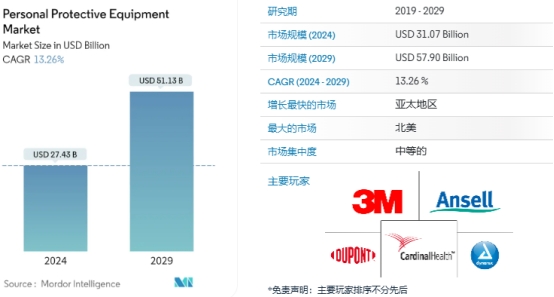
The estimated market size of personal protective equipment in 2024 is 27.43 billion US dollars, and it is expected to reach 51.13 billion US dollars by 2029, with a compound annual growth rate of 13.26% during the forecast period (2024-2029). The rapid growth of the construction industry and the continuous improvement of workplace employee protection awareness are the main factors driving the growth of the personal protective equipment market. As of July last year, the COVID-19 pandemic has affected nearly 183 million people worldwide, with an unprecedented increase in demand for medical safety and prevention products such as gloves, masks, workwear, gowns, goggles, and face shields. Therefore, the previously estimated growth of the personal protective equipment market has significantly increased. The COVID-19 pandemic has led to restrictions on the production of other industrial products, and many industrial product manufacturers have turned to PPE production, resulting in a sharp rise in some regional ecosystems. The Occupational Safety and Health Administration (OSHA) requires different categories of PPE to comply with or be equivalent to the standards established by the American National Standards Institute (ANSI). ANSI has been developing safety standards since the 1920s, when it approved the protection of industrial workers' heads and eyes. Falling is one of the main causes of death on construction sites; Therefore, it has become important to use appropriate protective equipment such as seat belts or respirators to protect the lungs from harmful gases, vapors, and particles. Infection control requires specific personal protective equipment for use throughout the medical space and must comply with FDA regulations. In addition, in terms of suppliers, surgical masks, N95 respirators, medical gloves, and protective clothing must comply with voluntary consensus protection standards.
Market Trends in Personal Protective Equipment (PPE)
Surgical masks and N95 respirators will see significant growth. Surgical masks are personal protective equipment used in mainstream applications to protect wearers from the effects of airborne particles and liquids contaminating the face. A study conducted by NIOSH showed that nearly 78% of respondents reported using surgical masks to address one or more hazards, with 14% using ribavirin and over 90% using surgical fumes. Therefore, surgical masks have been used in situations where respiratory protection is recommended, such as preparing or administering anti-tumor drugs and working near surgical fumes. Although surgical masks can effectively block splashes and large particle droplets, they can also block small particles transmitted through coughing, sneezing, or certain medical procedures, but these masks are not suitable for repeated use. On the other hand, N95 respirators are similar to the FFP2 and FFP3 standard masks in Europe, the latter being considered an ideal choice for protecting the nose and mouth area from spreading or inhaling viral particles. Due to COVID-19, wearing masks has become commonplace, not only in hospitals but also in all public places, leading to excessive consumption of surgical masks and N95 masks by the public. According to reports from multiple countries, this further leads to a severe shortage of surgical masks and N95 masks for frontline medical staff in patient care. The company has been expanding its market share through various strategic developments. For example, in August 2022, respiratory protection product manufacturer Optrel launched P Air Clear, an NIOSH approved N95 respirator with a transparent window. P Air Clear is a significant advancement for educators, healthcare workers, geriatrics, as well as the deaf, mute, and hearing-impaired communities. It provides maximum protection and has the additional advantage of transparent windows, eliminating communication barriers caused by traditional masks. In addition, in May 2022, the N95 project collaborated with the FXB Center for Health and Human Rights at Harvard University to provide 1 million free respirators to local communities.
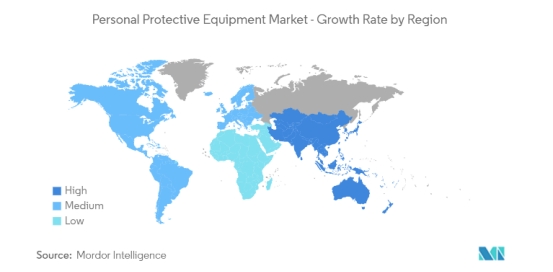
It is expected that North America will occupy a significant market share
The government's strict regulations on worker safety force companies to equip themselves with personal protective equipment and prevent fatalities at work. The increasing demand for regional products in the healthcare industry and awareness of preventing the spread of COVID-19 have also promoted the sales of personal protective equipment in the region. According to a report released by Statistics Canada in 2021, two-thirds (66.1%) of Canadian businesses stated that they require or anticipate the need for personal protective equipment (PPE) to operate in accordance with COVID-19 public health guidelines. Enterprises in the service production industry are most likely to require personal protective equipment, with education services (92.1%), healthcare and social assistance (84.3%), retail trade (84.0%), and accommodation and food services (79.5%) having the highest demand. Manufacturers in the region have been investing in product development activities and capacity expansion to meet the growing demand for personal protective equipment and have a positive impact. For example, in May 2022, Honeywell International launched two new NIOSH certified respiratory products, the DC365 and RU8500X series masks, to assist healthcare workers. These additional products expand Honeywell's personal protective equipment (PPE) product portfolio. In addition, the United States also has major market participants engaged in the manufacturing of personal protective equipment. 3M Co.、MSA Safety Inc.、Ansell Limited、Honeywell International Inc.、EI DuPont de Nemours and Co.、Kimberly-Clark Corporation、Lakeland Industries, Inc. Companies such as Radians, Inc. are also involved in promoting market growth in the region. In addition, the increasing number of occupational accidents and the demand for highly durable mechanical wear resistance and protective equipment in the oil and gas, automotive, refining, and metal manufacturing industries should drive the trend of the personal protective equipment market. The increase in workplace hazards and the strict regulatory framework established by the Occupational Safety and Health Administration to ensure employee safety are expected to drive growth in the North American market.